Free Cantonese Phrasebook
Learn Survival Cantonese
Wikitravel users have collectively created a free Cantonese phrasebook with the goal of making it possible for travelers to "get by" while traveling in areas where Cantonese is spoken.
Wikitravel phrasebooks are available in many languages and each one varies in depth and detail. Most of the phrasebooks include a pronunciation guide, a general phrase list, information about dates and numbers, a color list, transportation-related phrases, vocabulary for shopping and phrases for eating and drinking. Some are even more in depth, and all are free!
From Website
Cantonese (廣東話 Gwóngdūngwáh) is a widely spoken Chinese language. It is the local language in current use within the province of Guangdong, China, official language in the Special Administrative Region of Hong Kong, as well as in the Special Administrative Region of Macau, and used in many overseas Chinese communities in South-East Asia and elsewhere, with Kuala Lumpur and Ho Chi Minh City (Saigon) being two places where Cantonese is the dominant language in a Chinese community that is in turn huge and influential. Cantonese is also the dominant language in many Chinatowns all over the world, including Los Angeles, San Francisco, Seattle, New York, Chicago, London, Sydney, Melbourne, Perth, Vancouver, Toronto and Kuala Lumpur. The dialect of Chinese spoken by many inhabitants of eastern Guangxi Province in mainland China, is often referred to a form of Cantonese as well.
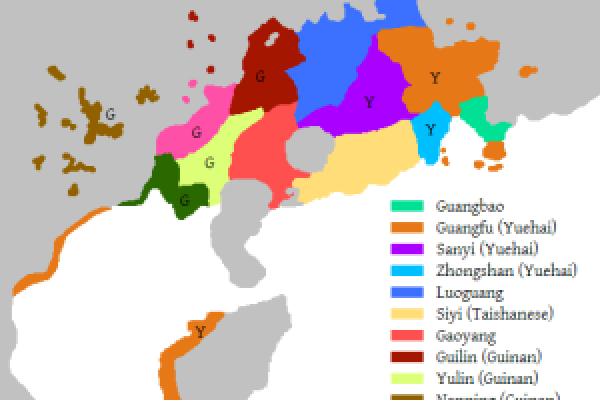
The word "dialect" means something different when applied to Chinese than it does for most other languages. Chinese "dialects" have not only widely diverging pronunciations of the same words, but also use different words for expressing the same thing, and different grammar such as different word order. As a result, different Chinese dialects can be mutually unintelligible. The difference between one dialect and another can be as small as that between, say, Spanish and Portuguese, or as large as that between German and English. Meanwhile, there are different variations of the Cantonese dialect that differ greatly from one another. For example, the Cantonese spoken in the far west of Guangdong province (eg. Taishan) is hardly or not at all intelligible to a native of Guangzhou city.
Speakers of all Chinese varieties do, in general, use the same characters in reading and writing. Written language is more formal and closer to standard Mandarin Póutūngwáh (Mandarin), even when used by Cantonese speakers. Oral Cantonese contains many words for which there has traditionally not existed a written form. In recent decades, however, characters for many of these words have been created, chiefly by the Hong Kong popular printed media such as newspapers and magazines. It should be noted that the different Cantonese-speaking communities use one of two different forms of writing: in Hong Kong, Macau, Malaysia and many overseas Chinese communities, traditional Chinese characters are in use, whereas the Cantonese-speaking communities in mainland China's Guangdong province as well as Singapore use simplified Chinese characters.
In many cases the regional varieties are not clearly regionalised but vary gradually across a region. Thus linguists can identify anywhere between seven and seventeen separate Chinese languages where the speakers of different dialects are mutually unintelligible. This list is based on the Cantonese spoken in Guangzhou. Note that the Cantonese spoken in Hong Kong and Macau differ slightly due to Western influences, though standard Cantonese as spoken in Guangzhou would be understood by everyone. The Cantonese spoken in Singapore and Malaysia also differ slightly due to Malay influences.
The issue of whether Yue is a language in its own right or a dialect of a single Chinese language depends on conceptions of what a language is. Like the other branches of Chinese, Yue is considered a dialect for ethnic, political, and cultural reasons, but it is also considered a distinct language because of linguistic reasons. Spoken Cantonese is mutually unintelligible with other varieties of Chinese, though intelligible to a certain degree in its written form.
The areas of China with the highest concentration of speakers are the provinces of Guangdong and (eastern) Guangxi and the regions of Hong Kong and Macau. There are also substantial Cantonese- and Taishanese-speaking minorities overseas in Southeast Asia, Canada, Australia, and the United States.
- 2710 reads


Post new comment