Afrikaans
Arabic
Bahasa
Bengali
Cantonese
Catalan
Chinese
Czech
Dutch
English
Farsi
Filipino
French
German
Greek
Hausa
Hebrew
Hindi
Hungarian
Indonesian
Italian
Irish
Japanese
Korean
Latin
Luxembourgish
Mandarin
Norwegian
Persian
Polish
Portuguese
Russian
Spanish
Swahili
Swedish
Tagalog
Thai
Turkish
Ukrainian
Vietnamese
Learn That Language Now! is a truly excellent, highly useful e-book for learners of any language - available for instant download to get you learning better right away. The study approach presented in the book is refreshing, exciting and even intoxicating, because it works so well once you start using it! Having personally learned six languages to varying degrees myself, I was pleasantly surprised to find many new tips and tricks that I'd never come across in over 15 years of studying and practicing foreign languages.
The author offers language learners perspective (earned through years of learning multiple languages) as well as practical methods you can start using right away to improve your language study flow and achieve fluency many times faster than with standardized methods.
This book provides essential information that will save you time and energy, helping you reach your goals faster and with more confidence. And with a low price tag of $19.99 USD, you will have a hard time finding a more valuable investment in your foreign language learning endeavors.
Finally, teachers will also benefit greatly from this book as it will give them insight into creating better study programs and stronger learning tools for their students.
Find out more about "Learn That Language Now!"
Learn That Language Now
What if I told you that you can become fluent in a foreign language in a matter of months, learn thousands of words without worrying about forgetting them, master grammar and do all of this in an enjoyable, painless manner. Sound too good to be true? Well, prepare to have your language learning experiences turned upside down. Read on to learn more...
What is “Learn That Language Now”?
Learn That Language Now is a comprehensive manual that will teach you the tips, tricks, techniques and method to achieve fluency in a foreign language with the goal of learning as quickly and fluently as possible with the least amount of effort.
Learn That Language Now was written because all other traditional methods of language learning, including classes, textbooks, audio courses and software programs, were slow, costly, inefficient and used language learning philosophies that were out-dated. Most language resources teach language along the same lines as languages were studied hundreds of years ago: endless grammar, syntactical rules and vocabulary lists.
UPDATE: Byki now available for 74 languages! See list below.
Byki is freeware for learning [74] languages, including many less-taught languages for which learning materials are hard to find, such as Georgian, Mongolian and Icelandic. This is a gold mine for folks interested in learning the basics of over [seventy] languages - with no budget!
Along with the freeware, learners have free access to the Byki user community where other users share vocabulary lists for all the languages, instantly providing you with loads of new, free content.
They also offer a commercial upgrade for $49 USD, reasonable, and you get lots of extras with the upgrade.
The free version has been used both by folks at Free Language and friends of those folks. Beginners especially seem to get a lot out of this software.
Afrikaans, Albanian, Altai, Arabic, Armenian, Azerbaijani, Bashkir, Belorussian, Bengali, Bosnian, Bulgarian, Buriat, Chechen, Chinese, Croatian, Czech, Danish, Dari, Dutch, Estonian, Farsi, Finnish, French, Georgian, German, Greek, Haitian Creole, Hausa, Hebrew, Hindi, Hungarian, Icelandic, Indonesian, Irish, Italian, Japanese, Kazakh, Korean, Latin, Latvian, Lithuanian, Luxembourgish, Macedonian, Malay, Mirandese, Mongolian, Norwegian, Pashto, Polish, Portuguese (Brazil), Portuguese (European), Romanian, Russian, Scottish, Serbian, Slovak, Spanish, Swahili, Swedish, Tagalog (Filipino), Tajiki, Thai, Turkish, Turkmen, Tuvan, Ukrainian, Urdu, Uzbek, Vietnamese and Zulu.
The folks at Byki are working hard to make more languages available in the near future.
As of September 5th, 2008, we’ve launched a whole new version of Byki (the artist formerly known as Before You Know It) with several new languages, and a beautiful new site. Be sure to check out the new ListCentral, with profile avatars). The new Byki has lots of great new stuff including new learning games and the new Byki blog.
Wikibooks is a great idea. Like Wikipedia, Wikibooks consists of content that is public domain, which means that anything you find there is reusable in any fashion you like. This means it is truly Free and Open for learning and teaching.
Currently the Polish Language Wikibook consists of a basic course for learning Polish covering pronunciation, nouns, genders, adjectives, question words and more.
As always with Wikimedia projects, you are free to improve on the information created by fellow humans!
The Polish language is a member of the Western Slavic group of the Indo-European family of languages. It is easiest to learn if one already knows some other related language.
The most closely related are other Western Slavic languages: Czech, Slovak, Kashubian and Sorbian. More distant are the Southern and Eastern Slavic languages like Russian, Ukrainian, and Serbo-Croatian. Even further, but still somewhat similar are the Baltic languages: Latvian and Lithuanian. Polish is spoken by a total of approximately 40 million people, making it the second most widely spoken Slavic language in the world, next to Russian, and whose influence is almost up to par with her bigger sister. Other Slavs, especially the Bulgars (who consider Polish the most popular third language there) understand Polish and can pick it up with not much effort.
Someone who doesn't speak any Slavic language, but speaks some other Indo-European language, may still find many similarities between Polish grammar and the grammar of that language as well as many similar words.
Learning Polish is very difficult for those who don't know any Indo-European language well, especially for those who speak only Chinese, Japanese, or Korean... but as long as you are committed to learning Polish it is possible. If you are familiar with any other Slavic language (i.e Russian), then you have an advantage as this group share very similiar grammatical structures as well as a common history among them from their rise as well-organised centralised kingdoms in the Middle Ages to the Communist era.
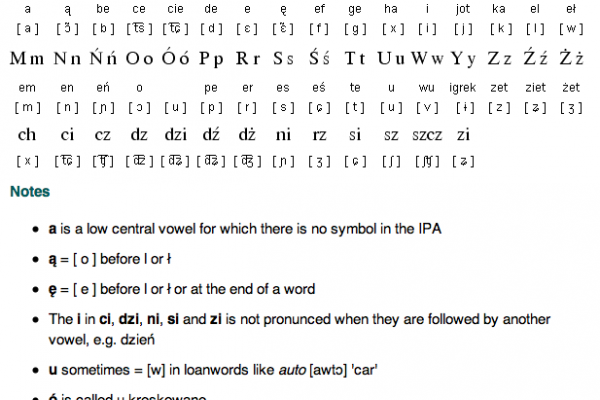
This Wikibook is designed for anyone who wants to learn the basics of the Polish language. It is suitable for beginners and those who've been learning the language for a few years. Polish is written with a particularly unique version of the Latin alphabet.
Quizlet.com is a great website for effectively learning vocabulary, for languages and anything else! For a quick video on how the whole thing works, check out the demo video. Cool fact: It was started by a 15-year-old high school student!
Basically, you can add and share vocabulary lists, make them public, private or share only with certain groups. Once you have them in the system (or you find an existing set you want to study), you can choose between several options for learning/familiarizing and self-assessment.
The site is slick, fast and has lots of active users. It's really a cool place to learn anything from the Greek Alphabet to TOEFL and SAT vocabulary and plenty more.
There are already gobs of lists available on the site - so many that individual attention is being brought to amazing collections available on the site, such as the HSK Test Vocabulary Preparation Pack and more.
So take a look at Quizlet when you get the chance. It's likely that content already exists for what you need to study! I have added this to all the language sections even though there are not vocabulary stacks yet for all of these. Reason being you can use the site to create any vocabulary lists you want - it's wide open!
The Quizlet Story
For lack of a professional writer working for Quizlet, here are some ramblings from me, Andrew Sutherland, creator of Quizlet, president of Brainflare, web developer, and high school student.
Quizlet is how I occupy my free time and even some of my non-free time. My mission for Quizlet is to make learning vocabulary not a chore. I know a lot of teachers assign vocabulary to students, but few students actually "absorb" words into their vocabularies after they take their test. Which kind of defeats the purpose, right? So Quizlet is my response - it aims to make learning fun, thus make learning effective. At the very least, it can help students do better on quizzes and tests even if they don't fully "absorb" their words.
I started Quizlet in October 2005, back when I was a mere 15-year-old (human years). I had just received a list of 111 French Animals to memorize from my magnanimous French teacher. I was puttering along with my dad with some call-and-response type quizzing. "Man, I love doing this" was NOT what I was thinking. So I put my thinking cap on, and the first line of code for Quizlet was written that night. Of course, that code was all deleted when I thought about what Quizlet would be. You really should plan first.
Quizlet is a shoestring operation. For its first 420 days, it was the work of only myself. I did all the designing, programming, debugging, and perfecting. The project had no product managers, no marketers, and no venture capitalists. It was just me and my testers. Recently I've realized some things are out of my field of expertise (I'm not a lawyer, for example). So there are a few other people involved these days.
Quizlet is free and will remain free to all users. The current plan is to offer targeted advertising on the non-studying pages. I'm hoping to make some deals with some educational and test-prep companies and perhaps some universities. If you're interested in advertising to my userbase of highly-motivated high-school and college students, shoot me a note (see above right).
Let's see, what haven't I covered? Ahh, the name Quizlet comes from Quizlette, the name of the "little" quizzes my French teacher gives. She could have charged royalties, but that just wouldn't be right…
And because you really want to know, I made Quizlet using only the finest ingredients:
PHP
MySQL
Apache
Mootools Thanks Valerio!
XHTML, CSS, Javascript, JSON, etc etc…
Anki is a cool little app for learning vocabulary words and phrases. It uses spaced repetition to help increase learning speed and memorization by repeating more often the terms you don't know and gradually decreasing those that you do.
The app is free and is available for Debian GNU/Linux, Windows, Mac OS X and as source code here. The software can be used to learn any language - just create the flashcards and it takes care of the spaced repetition for you.
Also available here is an online version of the software that works right through your web browser and stores your vocabulary on the Anki server. Great for people learning in Internet cafés!
Anki is a program designed to help you remember facts (such as words and phrases in a foreign language) as easily, quickly and efficiently as possible. To do this, it tracks how well you remember each fact, and uses that information to optimally schedule review times. With a minimal amount of effort, you can greatly increase the amount of material you remember, making study more productive, and more fun.
Anki is based on a theory called spaced repetition. In simple terms, it means that each time you review some material, you should wait longer than last time before reviewing it again. This maximizes the time spent studying difficult material and minimizes the time spent reviewing things you already know. The concept is simple, but the vast majority of memory trainers and flashcard programs out there either avoid the concept all together, or implement inflexible and suboptimal methods that were originally designed for pen and paper.
While Anki can be used for studying anything, it also ships with special features designed to make studying Japanese and English easier: integrated dictionary lookups, missing kanji reports, and more. Sample decks are also provided for Russian.
Anki's scheduling algorithm is based on the proven SM2 SuperMemo algorithm. It improves upon the basic SM2 algorithm by adding features like priorities and a revision queue sorted in order of priority.