Learn Languages Online and Mobile

Learn Languages Online

Get a free lesson right now from Babbel and enjoy real success learning Spanish, English, French, German, Italian, Portuguese, Swedish, Polish, Turkish, Indonesian and Dutch.

You Make Language Happen

Free Language Newsletter

Discover the magic of learning languages.

Subscribe to the Free Language Letter.

Your Name:

Your Email:

Ask Questions, Get Answers

Ask Language Questions

Ask anything about learning and teaching languages! Share your language questions.

View questions that have been asked and answered. Together we are creating a collective knowledge base for effective language learning and teaching. You can help!

one-on-one

Learn Portuguese with Babbel

Learn Brazilian Portuguese Quickly in Style

Babbel combines multi-media visual and auditory learning, social networking interactivity, sound educational methodology, mobile apps (for iPhone, iPod Touch and iPad - Babbel Mobile) and desktop goodies (Babbel Refresh) in a one-stop integrated platform for learning Portuguese.

They've very recently expanded their platform by adding loads of new features to the Web interface as well as mobile and desktop apps to enhance your Portuguese learning efforts online - and take them mobile:

Babbel Refresh: Bite-sized units catered to your individual Portuguese learning program, spaced out appropriately and delivered to your via a free desktop app! (Free, works with Windows and Mac.)

Babbel Mobile: Synchronizes your Babbel account with iPhone, iPod Touch and iPad, allowing you to study Portuguese on your mobile device - even if you're offline! Babbel Mobile is free to download for everybody, and access to the Vocabulary is available for free for those who already are subscribers to Babbel. If you're not on Babbel, you can purchase the vocabulary as a stand alone app, which has 3000 words and phrases, for a onetime $7.99 USD.

Your rating: None Average: 3.4 (21 votes)
PortuguesePod101

Proven Course Teaches Portuguese Quickly with Audio, Video & Apps

Beginner and advanced levels alike will enjoy PortuguesePod101, an excellent online and mobile way to learn Portuguese quickly.

PortuguesePod101's fun method and modern platform immerse you in the Portuguese language, giving you just what you need to achieve your goals for travel, business, family and other needs.

PortuguesePod101 is web and mobile based, giving you a custom Portuguese Learning Center anywhere. Download podcasts on your iPhone, Android, iPod Touch, iPod or any mp3 player and take them with you for practice and learning on the go.

High-Quality Content for Learning Portuguese

A key aspect to learning a language is quality content. PortuguesePod101 creates a steady flow of fresh content covering everything from cultural aspects of Portuguese to tidbits about navigating in Brazil to Portugal, Mozambique to Macao, plus practical information to help you get by.

Beyond Audio and Video

Engage in a combination of audio and video lessons, lesson notes and checklists, transcripts, PDFs, vocabulary training with flashcards and quizzes plus a Portuguese dictionary, grammar bank, a verb reference, social network and plenty more.

It's simple to get a free lifetime account.

Your rating: None Average: 5 (1 vote)

Wikipedia Learn Portuguese Language

Summary

If you don't know about Wikipedia, now is the time to find out! Especially since it is so useful in learning languages.

Wikipedia is the "Free Encyclopedia", a collectively-authored, dynamic, online encyclopedia that is free not only as in price, but also as in freedom. This means that the content you find anywhere on Wikipedia is free and open in the Public Domain. You can reproduce, redistribute and rehash the information there. This is empowered by the GNU Free Documentation License. This same license protects and empowers the contant on Free Language! (How?)

This particular resource links to the Wikipedia entry on the Portuguese language. This entry contains loads of information for the curious reader as well as for the serious Portuguese language learner, including historical and linguistic data.

Use this resource to become familiar with the Portuguese language and its context in today's world, to discover facts and linguistic data about Portuguese and its many varieties, access further information about and resources for learning Portuguese, and much more.

From Resource

Portuguese (português or língua portuguesa) is a Romance language that originated in what is now Galicia (Spain) and northern Portugal from the Latin spoken by romanized Celtiberians about 1000 years ago. It spread worldwide in the 15th and 16th centuries as Portugal established a colonial and commercial empire (1415–1999) which spanned from Brazil in the Americas to Goa in India and Macau in China. During that time, many creole languages based on Portuguese also appeared around the world, especially in Africa, Asia and the Caribbean.

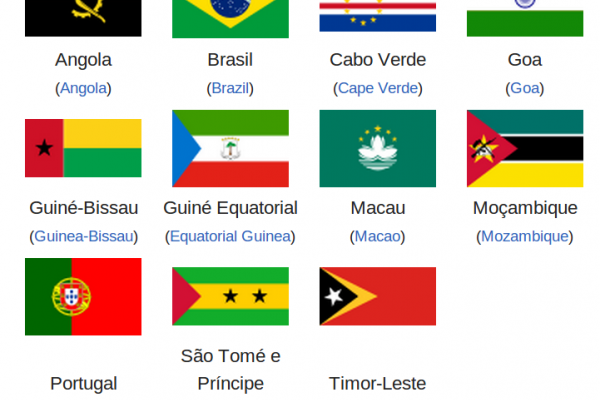
Today it is one of the world's major languages, ranked sixth according to number of native speakers (over 200 million). It is the language with the largest number of speakers in South America (188 million, over 51% of the continent's population), and also a major lingua franca in Africa. It is the official language of nine countries (see the table on the right), being co-official with Spanish and French in Equatorial Guinea, with Chinese in the Chinese special administrative region of Macau, and with Tetum in East Timor.

In July 2007, President Teodoro Obiang Ngumema announced his government's decision to make Portuguese Equatorial Guinea's third official language, in order to meet the requirements to apply for full membership of the Community of Portuguese Language Countries. This upgrading from its current Associate Observer condition would result in Equatorial Guinea being able to access several professional and academic exchange programs and the facilitation of cross-border circulation of citizens. Its application is currently being assessed by other CPLP members.

Spanish author Miguel de Cervantes once called Portuguese "the sweet language", whereas Brazilian writer Olavo Bilac poetically described it as a última flor do Lácio, inculta e bela: "the last flower of Latium, wild and beautiful".

Portuguese is the official language of Angola, Brazil, Cape Verde, Guinea-Bissau, Portugal, São Tomé and Príncipe and Mozambique. It is also one of the official languages of Equatorial Guinea (with Spanish and French), East Timor (with Tetum) and of the Chinese S.A.R. of Macau (with Chinese). It is widely spoken, but not official, in Andorra, Luxembourg, Namibia and Paraguay (in the latter country there were 112,520 native Portuguese speakers according to the 2002 census), and in the U.S. states of California, Connecticut, Florida, Massachusetts, New Jersey, New York, and Rhode Island. There is also a statistically significant Portuguese-speaking community (approximately 10,000 people) in Jersey. Portuguese Creoles are, while not officially recognized, the standard language for communication in Cape Verde and part of Guinea-Bissau's population. In Cape Verde most also speak standard Portuguese and have native level proficiency. There are also significant populations of Portuguese speakers in Canada (mainly concentrated in and around Toronto) and Bermuda. There are also small populations of speakers in the former Portuguese colonies of Goa and Daman and Diu which are now part of India.

Link

Visit "Portuguese Language" on Wikipedia.

License

GNU Free Documentation License

Your rating: None Average: 4 (2 votes)

Wikibooks Portuguese Logo

Summary

Wikibooks is a great idea. Like Wikipedia, Wikibooks consists of content that is public domain. That means that anything there is reusable in any fashion, such as for teaching.

The Wikibook for learning Portuguese is quite good and has a solid amount of materials to work with.

From Website

Welcome to the Portuguese Wikibook. Here you can learn the different parts to the Portuguese language through our grammar references and our course. Why not start with the feature word?

The Portuguese spoken in Brazil is quite different from the Portuguese spoken in Portugal in that the Brazilians tend to be more liberal with their use of the language. Also, the informal second person pronoun "tu" is almost never used. The word order is slightly different in certain circumstances, as is the preferred synonym for the same word. It is often easier to learn for beginners, and you will still be understood in Portugal.

Visit the Learn Portuguese Language Wikibook.

Website Content License

The content on this website is empowered by the GNU Free Documentation License (GNU FDL) and is, thus, free and open for everyone.

Screenshot

Wikibooks Portuguese Logo

Your rating: None Average: 4 (2 votes)

Easy Portuguese Logo

Summary

This website has easy-to-use, basic lessons and audio files for learning the Portuguese language. These materials are best suited for beginner to intermediate learners.

The site also has a list of useful phrases in Portuguese as well as vocabulary lists with audio.

Visit EasyPortuguese.com

Your rating: None Average: 3.5 (4 votes)