Afrikaans
Arabic
Bahasa
Bengali
Cantonese
Catalan
Chinese
Czech
Dutch
English
Farsi
Filipino
French
German
Greek
Hausa
Hebrew
Hindi
Hungarian
Indonesian
Italian
Irish
Japanese
Korean
Latin
Luxembourgish
Mandarin
Norwegian
Persian
Polish
Portuguese
Russian
Spanish
Swahili
Swedish
Tagalog
Thai
Turkish
Ukrainian
Vietnamese
LQToronto.com is the official website of the Institute of the Language of the Quran in Toronto. The website is not for profit, and offers all of the Madinah Arabic courses for free as downloads of the texts and viewing of the videos.
There is an amazing amount of material available for free on this website. It is enough to allow an individual learner to learn to read, write and speak the Arabic of the Qu'ran without any further materials - truly amazing!
Also on the website is a shop where you can purchase the texts at cost, with no additional fees. Finally, you may want have a look at and participate in the site's nascent forum.
V. Abdur Rahim was born in the small town of Vaniyambadi in the state of Tamil Nadu, India in 1933. After finishing his secondary school studies, he joined Presidency College, University of Madras where he majored in English Language and Literature. He graduated in 1957. In 1964, he joined al-Azhar University, Cairo, where he did his M.Phil. and Ph.D. in Arabic Philology.
It is to be noted that Abdur Rahim learnt Arabic by himself. The school where he did his secondary school studies offered Arabic, but the lessons it offered consisted of only memorizing the conjugation tables. Abdur Rahim detested this method. He thought that it was the most unnatural way of learning a language. Only dead languages like Latin, Syriac, etc. are taught this way. Living languages teach sentences straightaway. He decided to design a curriculum to teach Arabic to non-native speakers of Arabic.
In 1969, he joined the Islamic University of Madinah to teach Arabic Philology. Here, he was also associated with the Programme of teaching Arabic as a foreign language. The course he designed for this purpose is now known as Durûs al-Lughaħ al-‘Arabiyya ħ li-Ghair al-Nâtiqîna Bihâ. (Now these books are popularly known throughout the world as “MADINA BOOKS”.)
When he was learning Arabic by himself, Abdur Rahim studied the many problems that beset the non-native students of Arabic, and tried to solve them. He discovered that all these problems can easily be solved by applying the principle of taqdîm al- usûl ‘ala al-furû‘, i.e. teaching the primary elements before the secondary elements. The following are some of the manifestations of the application of this principle:
1. Teaching the primary case-endings before the secondary endings, so you teach the masrûf noun before the mamnû‘ min al-sarf, and the al-af‘âl al-arba‘aħ before the al-af‘âl al-khamsaħ.
2. Teaching the sâlim verb before the other categories.
3. Teaching the al-mudâri‘ al-marfû‘ before the al-mudâri‘ al-mansûb or al-mudâri‘ al-majzûm.
4. Teaching the plural of intelligent nouns before that of non-intelligent nouns.Another principle Abdur Rahim advocates is that rules of waqfshould not be applied during the teaching stage, for in that case the student cannot learn the correct ending of the last word in the sentence as, ma smu-ka and ma smu-ki, for example, are both reduced to ma smu-k.
The following are the books Dr. Abdur Rahim has written in field of teaching Arabic as a foreign language:
1. Durûs al-Lughaħ al-‘Arabiyyaħ (3 parts).
2. Key To Durûs al-Lughaħ al-‘Arabiyyaħ (3 parts).
3. Key To Exercises of Durûs al-Lughaħ al-‘Arabiyyaħ (3 parts).
4. Teachers' Guide To Durûs al-Lughaħ al-‘Arabiyyaħ (3 parts).
5. A Glossary of Words used in Durûs al-Lughaħ al-‘Arabiyyaħ.
6. Ahadith Sahlaħ.
7. Nusûs min al-Hadîth al-Nabawyyi al-Sharîf.
8. Nusûs Islâmiyyaħ.
9. From Esfahan To Madinah.
10. Al-Bâhith ‘an al-Haqq.
11. Innahumâ min Mishkâħ Wahidaħ.
12. Fi Balât Hiraql.
13. Abshir bi-Khayri Yawm.
14. Arba‘ûna Hadîthan.
15. Al-Mus‘if fî Lughati wa I‘râbi Suraħi Yûsuf.Currently, Dr V. Abdur Rahim is Director, Translation Centre, King Fahd Qur'an Printing Complex, Madinah Munawwarah.
ArabicPod.net is a quality podcast for learning the Arabic language. The audio podcast lessons are free! and two levels of membership are also available for a nominal price. These include transcriptions of the lessons and additional study materials.
Lessons are well-structured and tackle many difficult aspects of learning the Arabic language, such as difficult letters to pronounce and cultural idiomatic expressions. Meet the teachers here.
ArabicPod.net also has a number of videos available. Most of these are for paid subscribers but there are also some for free. You will also find a forum on the website. If you are a premium member, you have access to a place to share documents, images, links and more with other users.
The dialect taught on this podcast is "common colloquial" Arabic, common across all Arabic dialects, as well as Standard Arabic. Read more about this.
What is ArabicPod?
ArabicPod is a website dedicated to providing the most innovative and effective methods for learning Arabic. We use the latest technologies in web 2.0 to provide a rich learning experience delivering podcasts, videos, games and much more.
Where is it based?
ArabicPod is based in London. If you’re around town, then why don’t you contact us and arrange to meet the ArabicPod team or even join us as a guest in some of our lessons.
Is it free?
All of our audio podcasts can be freely listened to and downloaded. For most of the other content, there is a subscription fee which is setup to cover the costs of running the website.
Subscribe to ArabicPod.net.
Subscribe to ArabicPod.net Podcast via iTunes.
View ArabicPod.net's Feed on Free Language.
Omniglot is an excellent resource for learners of just about any major world language. Simon Ager has put together an exceptional amount of information about the systems used to express language in the written form, complete with images, explanations and audio samples.
This article in particular brings attention to Simon's resources regarding the Abjad (consonant alphabets) used for writing in Arabic.
There are two main types of written Arabic:
1. Classical Arabic - the language of the Qur'an and classical literature. It differs from Modern Standard Arabic mainly in style and vocabulary, some of which is archaic...
2. Modern Standard Arabic - the universal language of the Arabic-speaking world which is understood by all Arabic speakers. It is the language of the vast majority of written material and of formal TV shows, lectures, etc.
Visit Omniglot.com Arabic Alphabet, Pronunciation and Language
FSI is an acronym for the Foreign Service Institute, "the (US) Federal Government's primary training institution for officers and support personnel of the U.S. foreign affairs community".
Over the years, the FSI has researched, designed and taught language courses to Foreign Service staff and diplomats. These courses are now available and licensed to the Public Domain.
FSI-Language-Courses.com (and .net) is a sweet and simple website that provides users with the ability to view and download the Foreign Service Institute's courses for 31+ languages. The content is provided by individuals donating time and resources in an overall effort to provide quality languages-learning materials for free worldwide.
Sounds good to me. :)
In the Arabic section of the site, there are currently 5 courses available for download:
Welcome to fsi-language-courses.com, the home for language courses developed by the Foreign Service Institute. These courses were developed by the United States government and are in the public domain.
This site is dedicated to making these language courses freely available in an electronic format. This site is not affiliated in any way with any government entity; it is an independent, non-profit effort to foster the learning of worldwide languages. Courses here are made available through the private efforts of individuals who are donating their time and resources to provide quality materials for language learning.
Visit FSI-Language-Courses.com
US Foreign Service Institute Website
US Foreign Service Institute on Wikipedia.
This site has a good selection of online games and activities for learning the Arabic language.
There are also many other languages available on the site.
Digital Dialects was launched in January 2007, originally a by-product of a dissertation reviewing web resources for language learning. The site was conceived as an educational tool for learning languages, and as a guide to online resources.
All animation and webpage design is by Craig Gibson. The animated activities are intended to incorporate the interactivity of computer aided language learning software with the web-design principle of simplicity in use and access. In essence the games are intended to provide a relaxed way of acquiring basic language skills, a break from the books!
The site will continue to be a work in progress, and it is intended that Digital Dialects will represent the World’s major languages, with a cross-section of languages from diverse regions. Audio files are to be gradually incorporated into animations for certain languages. The development of particular language sections will be dependant on assistance from translators and native speakers.
Khaled has created an excellent online resource for learners of the Arabic language that are already familiar with Arabic script. He has beginner and advanced tutorials as well as translation anecdotes.
On the site you will learn about such concepts as gender, case forms, prepositions, pronouns, verbs, possessive, cases, adjectives and definite and indefinite articles.
Introduction
This course will enable you to learn the Arabic language through simple, easy-to-follow lessons in plain English. The lessons are designed so that the learner avoids common mistakes made by beginners when learning this wonderful language. They also try to avoid providing too many details at the beginning, and complexity is only added in later lessons gradually.
Requirement
You must be able to read/write Arabic script with sufficient ease to be able to make use of this course. For example, if you can read the Quran you are ready.
If you can already read/write Arabic script, click here to start this course. If not, click here for resources to learn the Arabic alphabet (on other sites).
Advanced
If you are familiar with the language, and its quite some time since you started you may have reached a level where you can take a look here.
About the siteThis site is one of Khaled's creation. It is quite new, and for the time being is updated often enough, so drop by often to check what's new.
DILAP is a publishing company and offers books for student of the Arabic language. They have a cool web tools for Arabic learners: animated Arabic script with simultaneous audio.
They also have some general information for Arabic learners of the beginning level, as well as an RSS feed for site updates.
The gates of the Arabic language
The reasons why we feel attracted to a foreign language are always quite personal; they depend on our own story and on our own background. Learning a language may at first sight look complex, demanding and time consuming.
That is why Dilap has come up with the idea of having several points of entry to the language, called gates.
make it possible to learn the language in different ways, none of them necessarily being a full approach to it but still remaining both fast and concrete ways to apprehend it. In that way the Great Gate to the Arabic language for a beginner would be our comprehensive teaching method called "Al-Manhaj" which will teach the learner the basics in grammar, spelling, phonetics, writing and vocabulary. Yet for those attracted to the mysteries of Arabic writing...
Our handbook entitled "Kitaba or the correct writing of Arabic" would be the ideal gate. Besides being a thorough collection of letter spellings, this book, which goes with a 65-minute audio cd, is a real phonetic gold mine to help the beginner become familiar with and absorb the accent, the pronunciation and the music of the Arabic language.
The appeal for the language may come from a desire to be able to exchange immediately in the oral, dialectal Arabic. If so, the best gate would be our handbook called "dialectal Al-Manhaj", which has been devised in relation to our book dealing with litteral Arabic, namely "Al-Manhaj". It tackles the learning of the oral, North African dialect in much the same thorough and methodological way. Each word or phrase is given its equivalent in written Arabic as well as its variants in the Moroccan, Tunisian and Algerian dialects.
Last of all, for intermediate learners who want to get a better grasp of part of the Arabic literature and culture, our book called "Sufis, Lovers and Eyes", which introduces many illustrated, handwritten texts, and goes with an Arabic/French lexicon, will be the appropriate gate to rapid, cursory reading.
Incredible! This is an amazing free textbook with supplementary audio for learning the colloquial Syrian Arabic spoken in Syria, Lebanon and Jordan.
Free Syrian Colloquial Arabic Course
Syrian Colloquial Arabic, a Functional Course by Mary-Jane Liddicoat, Richard Lennane and Dr Iman Abdul Rahim, 1998 ISBN 0-646-36958-X
Syrian Colloquial Arabic, a Functional Course is a 400-page illustrated and fully indexed textbook, accompanied by 180 minutes of authentic recorded conversations.
It deals with modern colloquial Arabic as it is spoken in Syria, Lebanon and Jordan, with an emphasis on practical, everyday language useful to the foreign resident.
Use it for:
* self-study,
* with a teacher
* or in a class.The downloadable book leads you through a variety of real-life situations, and the language necessary to deal with them — directing a taxi, negotiating for a hotel room, haggling with the greengrocer, speaking on the telephone, and so on.
This practical material has also been carefully fitted to a structured exposition of Arabic grammar. Read more about our methodology.
The book also covers basic reading and writing.While written Arabic is generally Modern Standard Arabic, an ability to read road and shop signs, Arabic numbers, restaurant menus and bills, and to write your name and telephone number is a valuable skill for the Arabic speaker.
The book is fully transliterated and can be used without learning to read Arabic, but we do recommend making the extra effort as this will help you if you go on to study Modern Standard Arabic.
With comprehensive vocabulary lists and full index, Syrian Colloquial Arabic is designed to be a handy reference even after you have finished the course!
This site has put together an easy download of the Foreign Language Institute's Arabic language learning program.
Learn Arabic like the diplomats, FBI, DEA agents did - with the original material developed by the US State Department’s Foreign Service Institute (FSI).
Rosetta Stone doesn't want you to know this! The best deals on Rosetta Stone software can be found here on eBay.
Rosetta Stone is proprietary language-learning software produced by Rosetta Stone, Ltd. Its title and its logo are an allusion to the Rosetta Stone, an artifact inscribed in multiple languages that helped researchers to decipher Ancient Egyptian by comparing it to the Greek inscription.
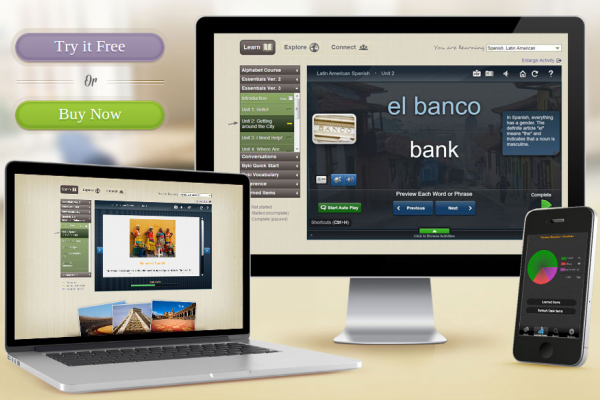
The Rosetta Stone software utilizes a combination of images, text, and sound, with difficulty levels increasing as the student progresses, in order to teach various vocabulary terms and grammatical functions intuitively, without drills or translation. Their method is called the Dynamic Immersion method. The goal is to teach languages the way first languages are learned.
Several different packages of lessons are available. The full course in each language is separated into three levels. There is only one level available for Latin. All retail software packages except the homeschool version contain two CDs, one with the application software and another with the instruction. The homeschool version also consists of disks for a server program and a student management program.
Get the best prices here on all Rosetta Stone products!
Arabic (Modern Standard), Chinese (Mandarin), Danish, Dutch, English (American), English (British), French (Parisian), German, Indonesian, Swahili, Tagalog (Filipino), Greek, Hebrew, Hindi, Indonesian, Irish, Italian, Japanese, Korean, Latin, Persian (Farsi), Pashto, Polish, Portuguese (Brazil), Russian, Spanish (Latin America), Spanish (Spain), Swedish, Swahili, Tagalog (Filipino), Thai, Turkish, Vietnamese and Welsh
All languages except Latin use the same set of words and sentences in the same order, with the same images (some of which are recycled from lesson to lesson). There are three levels of instruction, each sold separately, or they can be purchased bundled for a discount. In version two, most languages were offered with only two levels, though a few were offered in a third:
Level 1 consists of eight units, starting from simple vocabulary such as "boy", "girl", "man", "woman", moving up through numbers, the past and future tenses and concluding with a unit on giving directions. Units 1 through 4 have 10 lessons plus a review lesson, units 5 through 8 have 11 lessons plus a review lesson. 92 total lessons in level 1.
Level 2 offers units 9 through 19; however as a practical matter there are only nine units devoted to instruction since units 18 and 19 are "glossary" units devoted to single words having to do with a particular topic (school, nature, automobiles etc.). Level 2 units consider more advanced grammatical concepts, as well as specific subjects like banking, shopping and travel. These exercises also use short video clips in QuickTime format to illustrate some verbs. Units 16 and 17 consist solely of old Saturday Evening Post cartoons and their captions. 118 total lessons in level 2.
Level 3 is no longer offered on version 2 products, but when it was, it used longer video and writing passages to expand the level of instruction.
In version 3, all languages have three levels, though what they cover is different; there is more of a focus on conversation and less on complex grammatical topics.
Level 1 consists of four units, each with four thirty-minute lessons and a number of five to fifteen minute activities. The level, which is supposed to "build a foundation of fundamental vocabulary and essential language structure," takes about 24 hours to complete following Rosetta Stone's recommended course. Starting from simple vocabulary such as basic greetings, "boy", "girl", "man", and "woman", moving up through numbers, comparisons, adjectives, nouns, future tense, and telling time. Each unit also contains a ten-minute simulated conversation called a "Milestone."
The four units in Level 1 are: The Basics, Friends and Family, Work and School, and Shopping.
Level 2 offers units 5 through 8, for a total of about twenty-four hours designed to teach you to "navigate your surroundings as you build on the vocabulary and essential language structure in Level 1." More grammar is covered, including past and future tenses, and imperative forms. Topics such as giving directions, writing letters, workplace terms, apologies, discussing emotions, and criticizing art are also covered. As in Level 1, each unit is followed by a ten-minute "Milestone."
The four units in Level 2 are: Travel, Past and Future, Friends and Social Life, and Dining and Vacation.
Level 3 offers the final four units (9 through 12), which are supposed to help "connect with the world around you by building on the language fundamentals and conversational skills you developed in Levels 1 and 2." In addition to expanding upon grammar learned in Levels 1 and 2, Level 3 teaches more in depth vocabulary, including botanical terms, culinary terms, how to express detailed opinions and judgments, and how to discuss politics, religion, and business. As in the first two levels, each unit contains a ten-minute "Milestone" activity in which the user participates in a simulated conversation.
The four units in Level 3 are: Home and Health, Life and World, Places and Events, and Talking About the World.
An Explorer package consisting basically of the first three units from Level I was available for a much cheaper price than the full Level I. This product is no longer available from the publisher.
A Traveler version, consisting of several lessons focusing on basic terms as well as vocabulary important for travel, was produced in the late 1990s and is no longer available.
Audio Companion was released on June 9, 2008 and is meant to reinforce what is learned using the computer software. It is portable and is meant to be played on a CD player or MP3 player.
The best deals on Rosetta Stone software can be found here.