Free Language

Lessons, Podcasts, Courses, Audio, Video, Study Guides, Learning Materials


Need Results Now?

Rosetta Stone - Fastest way to learn a language.


Global Talk Free

Skype - call the world at rock bottom prices

Bloggy Stuff

Learn with Lingro

Creates clickable translations into the language you select.

The Free Language Letter

Keep informed with the latest!

eBay Auctions


New! :)

Rosetta Stone Arabic 3-Month Subscription

learning environment

ItalianLingQ.com Italian LingQ Podcast with iTunes MP3 Audio using Linguist Method by Steve Kaufmann

Learn Italian Language LingQ

Summary

It's difficult to "summarize" the booming expansion that has occurred with the Kaufmann crew since "The Linguist" appeared on Free Language a year ago. That is why Free Language has numerous articles on the various websites and resources available through multilinguist Steve Kaufmann's web entelechy, including the many LinqQ [liŋk] podcasts, the LingQ method, revisiting The Linguist on Language and why not throw in a little thelinguist.com love, too. :)

This particular podcast is ItalianLingQ, a roughly weekly podcast with mp3 audio content for Italian language learners. Transcripts of the podcasts are available through LingQ.

From Website

What is ItalianLingQ?

First of all, the name itself (which is pronounced Italian Link) needs a little explaining. The first part, “Italian”, is fairly obvious since we teach Italian. LingQ is the name of our online learning system which you can find at LingQ.com. At LingQ you’ll study many different languages in a fun, community atmosphere. The “Ling” in LingQ comes from TheLinguist.com the people behind LingQ. Lastly, the “Q” is important because it forms the speech bubble in our logo and throughout our site and because it makes “lingq” sound like “link” (we think!) which is what our system does for you.

At ItalianLingQ...

. we LingQ you to a world of real Italian content
. we LingQ you to our revolutionary learning tools
. we LingQ you to a community of fellow Italian learners

Our podcasts may contain interviews, articles, or audiobook excerpts but are most often just general conversations in Italian. We will usually talk about topics of general interest. Please do send us feedback and topic requests. We’re always happy to hear from you.

After you listen to the podcast, sign up for a free account at LingQ (l-i-n-g-q.com) and study the full transcript using LingQ's revolutionary learning tools.

At LingQ, you may also want to submit writing for correction or join live 1 on 1 and group discussions with our tutors. Plus you will find thousands more podcasts with transcript. Come and find out what LingQ is all about!

Of course, even if you don’t decide to become a member, you can continue listening to the podcasts as long as you like.

Visit ItalianLingQ.com

Subscribe

Subscribe to ItalianLingQ PodcastSubscribe to ItalianLingQ Podcast.
Subscribe to ItalianLingQ Podcast via iTunes.

LingQ Podcast Network

EnglishLingQ
FrenchLingQ
GermanLingQ
ItalianLingQ
JapaneseLingQ
PortugueseLingQ
RussianLingQ
SpanishLingQ
SwedishLingQ


Babbel.com Virtual FlashCard Language Share Site w/English, French, German, Italian, Spanish Tools and Video Game-Like Interface

Babbel Online Foreign Language Learning Environment

Summary

Babbel.com is the bomb. Not babble or Babel but Babbel! It's a website with slick tools and a smooth interface (modeled after a video game console) geared primarily towards learning and retaining loads of vocabulary terms and key phrases through audio visual.

The interface is pure eye candy and it loads quickly (I use a standard DSL connection) and works solidly. I have been testing Babbel out for a while now and it has never gotten buggy on me. The system tests me on terms and phrases I have already learned while incorporating new ones about topics that I elect and, thus, are more likely to be interesting and useful to me.

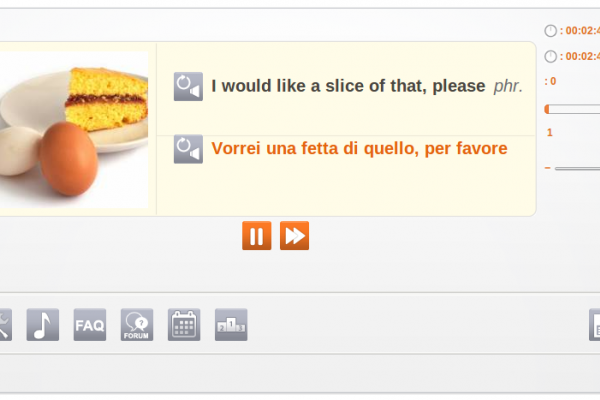
This excellent virtual flash card software also allows users to upload images to represent vocabulary items (be they nouns, verbs, phrases or what have you) and improve the learning experience for others. Users rate these images on how relevant they are for the term they represent, collectively choosing what most people feel best represents that term or phrase.

The flash card stacks are organized into "packages" (groups of cards) that treat a common theme, such as youth hostels, winter sports, restaurants and eating out, fruits and vegetables, clothing, standard greetings, giving and receiving compliments, etc. With input and contributions from the users, these packages get consistently better as more folks contribute.

Babbel Foreign Language Virtual Flash Card Tools and Exchange Community

Add to this the social twist that Babbel offers - the ability to hook up with other users interested in sharing language skills - and you have a well-rounded platform for beginners to excel rapidly in their first weeks and months working with a new language.

Currently, Babbel offers these features for learners of English, French, German, Italian and Spanish. This site is also localized in those languages, so if you like a challenge you can learn German in French, study Spanish in Italian, etc. This is cool for people who already have enough knowledge in a foreign language to understand and navigate the interface and can simultaneously maintain one language while learning a new one! I am learning German through the site, and I have chosen German as the interface language. That's another option for total immersion in the target language.

Thanks and many props to the folks at Babbel. :) I will definitely continue using the site to learn German - and I'll be waiting for more languages to appear on soon.

NB: Babbel isn't just a website, it is a full Web-software-powered environment for foreign language learning built with Flex. You'll need the latest Adobe Flash Player for your browser to enter the learning space. I recommend using Firefox for the best possible browsing experience.

From Website

Babbel.com Brings the Whole World Home

A new website with a social twist makes language learning easy and fun

Up until now, the best way to learn a language -- besides, maybe, in the classroom -- was to pack a bag, get on a plane or a train, and immerse yourself abroad. But what if you could learn, say, French, while eating a croissant in your own home and meet a real Parisienne in the process?

The idea of Babbel.com, the new, free language learning website with a social twist, is just that. This playful application is ideal for a quick start into a new language. With a design inspired by a game console, Babbel makes picking up new vocabulary effortless. But it also enriches and motivates by connecting you with the best teachers around: other Babbel users.

Babbel Web Software for Language Learning

Babbel is truly multimedia, incorporating human voices and user-generated images into the teaching of real-life vocabulary. In Babbel's current languages of English, German, Spanish, French and Italian, you can learn, for example, how to shop for groceries, express your feelings, or flirt. In place of the traditional flash cards, an effective and "intuitive" repetition system makes cementing new content easy. Meanwhile, the unique Refresher tool tracks your learning progress and reminds you what to review.

A participatory experience, Babbel relies on you and its other users to create much of its content. Through a clean, easy-to-use interface, you can make a personal profile, finding a a "Tandem" partner who speaks the language you are learning as a native, or a "learning partner" studying the same language. You also can upload pictures that correspond to vocabulary, and then their relevance is voted on by native speakers before they are included in lesson packages. An extra fun aspect is a high-score tracker, which compares your progress with other users, like a video game.

And now, a new Board multiplies the opportunities for connecting by allowing you to chat real-time about -- or in -- your learning language. It has a section to find and check translations, search for alternatives to fixed phrases, or express spelling or grammatical doubts. There, you can also get in contact with people living in places you may be traveling, ask for tips, or even find a couch to crash on!

As users progress in their language studies, Babbel is fast developing, too. It has just launched full localized interfaces for native Spanish and French speakers, in addition to the current English and German ones.

Babbel is enthusiastically designed by a team of young software experts and language-instruction professionals at the Berlin-based company Lesson Nine. Founders Thomas Holl and Toine Diepstraten have many years of application development, IT management, community cultivation and interactive media experience. The other two founders, Lorenz Heine, was a co-founder and CFO of Native Instruments, and has extensive entrepreneurial experience in the software industry, while Markus Witte has online marketing and management experience, and a solid academic grounding in language, cultural theory and media. Content Manager Ulrike Kerbstat holds Master's degrees in language instruction and interpreting, and is fluent in German, English and French.

Through word-of-mouth, positive response from users, and excitement in the worldwide media, the number of Babbel users has increased at an astounding rate in places as far-flung as Caracas, Manhattan and Mumbai. And the best part is that, for the time being, learning for example how to order a Tapa in a Spanish bar costs a lot less than flying to Madrid: It's free.

Visit Babbel.com and start learning a new language in seconds.


CaféBabel.com Café Babel Local European Political, Economic and Cultural News Magazine in Italian and 6 Other Languages

CaféBabel European Magazine Beta

Summary

Café Babel is a multilingual European political, economic and cultural news magazine published by over 20 local teams in many EU countries. The site has news, cultural and linguistic goodies in catalá, Deutsch, English, español, français, italiano and polski.

Café Babel publishes several mini-magazines that bring light to several topics:

The growing network of local teams that makes up Café Babel are European youths interested in and focused on trans-European world affairs, politics, society, economy and culture. To get a more personal look at some of the members of this team (the ladies, at least), have a look at this flickr photo album of The Women of Café Babel. Pretty cool, and it makes it more personal. (Miglena, Araceli, Camelia: if you read this drop me a line. :)

This particular news feed is the Italian language site-wide RSS feed. You can use it to keep up with what's hot over at Café Babel and practice your Italian or give students some current events to work with. Many of the articles are written in multiple languages, providing learners and educators alike with excellent material.

CaféBabel Multilingual European Magazine Screenshot

From Website

cafebabel.com is made up of a network of local teams across Europe. Bringing together young people from across the continent, this network aims to contribute to the construction of pan-European public opinion through the cafebabel.com magazine.

The local teams are cafebabel.com’s backbone. Their function? To propose subjects for issues, articles and interviews; to recruit writers and translators; to promote cafebabel.com; and to organise ‘café debates’ and events. Interested in setting up a local cafebabel.com team?

Visit CaféBabel.com

Subscribe

Subscribe to CaféBabel News in ItalianSubscribe to CaféBabel News in Italian
View CaféBabel News in Italian's Feed on Free Language.


Learn about the Italian Language at Wikipedia, the Free Encyclopedia

Wikipedia Learn Italian Language

Summary

If you don't know about Wikipedia, now is the time to find out! Especially since it is so useful in learning languages.

Wikipedia is the "Free Encyclopedia", a collectively-authored, dynamic, online encyclopedia that is free not only as in price, but also as in freedom. This means that the content you find anywhere on Wikipedia is free and open in the Public Domain. You can reproduce, redistribute and rehash the information there. This is empowered by the GNU Free Documentation License. This same license protects and empowers the contant on Free Language! (How?)

This particular resource links to the Wikipedia entry on the Italian language. This entry contains loads of information for the curious reader as well as for the serious Italian language learner, including historical and linguistic data.

Use this resource to become familiar with the Italian language and its context in today's world, to discover facts and linguistic data about Italian and its many varieties, access further information about and resources for learning Italian, and much more.

From Resource

Italian (italiano or lingua italiana) is a Romance language spoken by about 63 million people, primarily in Italy. In Switzerland, Italian is one of four official languages. It is also the official language of San Marino. Standard Italian, adopted by the state after the unification of Italy, is based on Tuscan dialect and is somewhat intermediate between Italo-Dalmatian languages of the South and Northern Italian dialects of the North.

Unlike most other Romance languages, Italian has retained the contrast between short and long consonants which existed in Latin. As in most Romance languages, stress is distinctive. Of the Romance languages, Italian is considered to be one of the closest resembling Latin in terms of vocabulary, though Romanian most closely preserves the noun declension system of Classical Latin, and Spanish the verb conjugation system (see Old Latin), while Sardinian is the most conservative in terms of phonology.

The history of the Italian language is long, but the modern standard of the language was largely shaped by relatively recent events. The earliest surviving texts which can definitely be called Italian (as opposed to its predecessor Vulgar Latin) are legal formulae from the region of Benevento dating from 960-963. Italian was first formalized in the first years of the 14th century through the works of Dante Alighieri, who mixed southern Italian languages, especially Sicilian, with his native Tuscan in his epic poems known collectively as the Commedia, to which Giovanni Boccaccio later affixed the title Divina. Dante's much-loved works were read throughout Italy and his written dialect became the "canonical standard" that others could all understand. Dante is still credited with standardizing the Italian language and, thus, the dialect of Tuscany became the basis for what would become the official language of Italy.

Italian has always had a distinctive dialect for each city, since the cities were until recently thought of as city-states. The most characteristic differences, for instance, between Roman Italian and Milanese Italian are the gemination of initial consonants and the pronunciation of stressed "e" and "s" in some cases (e.g. va bene "all right": is pronounced [va ˈbbɛne] by a Roman, [va ˈbene] by a Milanese; a casa "at home": Roman [a ˈkkasa], Milanese [a ˈkaza]).

In contrast to the dialects of northern Italy, the older southern Italian dialects were largely untouched by the Franco-Occitan influences introduced to Italy, mainly by bards from France, during the Middle Ages. (See La Spezia-Rimini Line.) The economic might and relative advanced development of Tuscany at the time (Late Middle Ages), gave its dialect weight, though Venetian remained widespread in medieval Italian commercial life. Also, the increasing cultural relevance of Florence during the periods of 'Umanesimo (Humanism)' and the Rinascimento (Renaissance) made its volgare (dialect), or rather a refined version of it, a standard in the arts. The re-discovery of Dante's De vulgari eloquentia and a renewed interest in linguistics in the 16th century sparked a debate which raged throughout Italy concerning which criteria should be chosen to establish a modern Italian standard to be used as much as a literary as a spoken language. Scholars were divided into three factions: the purists, headed by Pietro Bembo who in his Gli Asolani claimed that the language might only be based on the great literary classics (notably, Petrarch, and Boccaccio but not Dante as Bembo believed that the Divine Comedy was not dignified enough as it used elements from other dialects), Niccolò Machiavelli and other Florentines who preferred the version spoken by ordinary people in their own times, and the Courtesans like Baldassarre Castiglione and Gian Giorgio Trissino who insisted that each local vernacular must contribute to the new standard. Eventually Bembo's ideas prevailed, the result being the publication of the first Italian dictionary in 1612 and the foundation of the Accademia della Crusca.
Italian literature's first modern novel, I Promessi Sposi (The Betrothed), by Alessandro Manzoni further defined the standard by "rinsing" his Milanese 'in the waters of the Arno" (Florence's river), as he states in the Preface to his 1840 edition.

After unification a huge number of civil servants and soldiers recruited from all over the country introduced many more words and idioms from their home dialects ("ciao" is Venetian, "panettone" is Milanese etc.).

Link

Visit "Italian Language" on Wikipedia.

License

GNU Free Documentation License


Rosetta Stone Learn Italian Language Software Level 1 (Commercial)

Rosetta Stone Italian Level 1

Rosetta Stone Italian Level 1

With over 3500 real-life images and phrases in 92 lessons, Italian Level 1, Personal Edition provides up to 250 hours of mastery instruction in Listening Comprehension, Reading, Speaking, and Writing. Systematic structure teaches vocabulary and grammar naturally, without lists and drills. Previews, exercises and tests accompany every lesson with automated tutorials throughout the program. Level 1, Personal Edition provides instruction in such categories as People and Talking; Directions; Food, Eating and Drinking; Family Relationships; Telling Time; Numbers to One Hundred; Clothing and Dress; Vehicles, Furniture and Instruments; Shapes, Colors and Location; And Much More. Italian Level 1, Personal Edition comes complete with an illustrated User's Guide and a Curriculum Text book.


Comments

Rosetta Stone has made a name for itself selling proprietary software that allows people to quickly and easily learn languages interactively.

You may have seen them selling their wares in the airport or on TV.

Software License

Rosetta Stone is proprietary software.

View specific license for your country.

Not to be confused with the Free Software GPL Rosetta Stone Library.


Syndicate content

Sales and Deals

Transparent Language