Afrikaans
Arabic
Bahasa
Bengali
Cantonese
Catalan
Chinese
Czech
Dutch
English
Farsi
Filipino
French
German
Greek
Hausa
Hebrew
Hindi
Hungarian
Indonesian
Italian
Irish
Japanese
Korean
Latin
Luxembourgish
Mandarin
Norwegian
Persian
Polish
Portuguese
Russian
Spanish
Swahili
Swedish
Tagalog
Thai
Turkish
Ukrainian
Vietnamese
Front Page
Blog Entries
Newsletter
Afrikaans
Arabic
Bahasa
Bengali
Cantonese
Chinese
Czech
Dutch
English
Farsi
Filipino
French
Greek
German
Hausa
Hebrew
Hindi
Hungarian
Indonesian
Italian
Japanese
Korean
Latin
Mandarin
Persian
Polish
Portuguese
Russian
Spanish
Swahili
Swedish
Tagalog
Thai
Turkish
Ukrainian
Vietnamese
Wikibooks is a great idea. Like Wikipedia, Wikibooks consists of content that is public domain, which means that anything you find there is reusable in any fashion you like. This means it is truly Free and Open for learning and teaching.
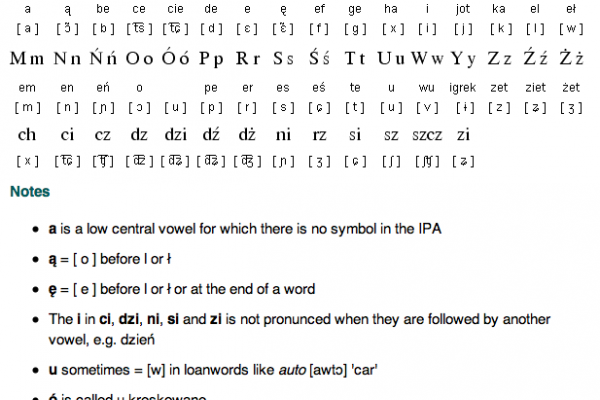
Currently the Polish Language Wikibook consists of a basic course for learning Polish covering pronunciation, nouns, genders, adjectives, question words and more.
As always with Wikimedia projects, you are free to improve on the information created by fellow humans!
The Polish language is a member of the Western Slavic group of the Indo-European family of languages. It is easiest to learn if one already knows some other related language.
The most closely related are other Western Slavic languages: Czech, Slovak, Kashubian and Sorbian. More distant are the Southern and Eastern Slavic languages like Russian, Ukrainian, and Serbo-Croatian. Even further, but still somewhat similar are the Baltic languages: Latvian and Lithuanian. Polish is spoken by a total of approximately 40 million people, making it the second most widely spoken Slavic language in the world, next to Russian, and whose influence is almost up to par with her bigger sister. Other Slavs, especially the Bulgars (who consider Polish the most popular third language there) understand Polish and can pick it up with not much effort.
Someone who doesn't speak any Slavic language, but speaks some other Indo-European language, may still find many similarities between Polish grammar and the grammar of that language as well as many similar words.
Learning Polish is very difficult for those who don't know any Indo-European language well, especially for those who speak only Chinese, Japanese, or Korean... but as long as you are committed to learning Polish it is possible. If you are familiar with any other Slavic language (i.e Russian), then you have an advantage as this group share very similiar grammatical structures as well as a common history among them from their rise as well-organised centralised kingdoms in the Middle Ages to the Communist era.
This Wikibook is designed for anyone who wants to learn the basics of the Polish language. It is suitable for beginners and those who've been learning the language for a few years. Polish is written with a particularly unique version of the Latin alphabet.
Quizlet.com is a great website for effectively learning vocabulary, for languages and anything else! For a quick video on how the whole thing works, check out the demo video. Cool fact: It was started by a 15-year-old high school student!
Basically, you can add and share vocabulary lists, make them public, private or share only with certain groups. Once you have them in the system (or you find an existing set you want to study), you can choose between several options for learning/familiarizing and self-assessment.
The site is slick, fast and has lots of active users. It's really a cool place to learn anything from the Greek Alphabet to TOEFL and SAT vocabulary and plenty more.
There are already gobs of lists available on the site - so many that individual attention is being brought to amazing collections available on the site, such as the HSK Test Vocabulary Preparation Pack and more.
So take a look at Quizlet when you get the chance. It's likely that content already exists for what you need to study! I have added this to all the language sections even though there are not vocabulary stacks yet for all of these. Reason being you can use the site to create any vocabulary lists you want - it's wide open!
The Quizlet Story
For lack of a professional writer working for Quizlet, here are some ramblings from me, Andrew Sutherland, creator of Quizlet, president of Brainflare, web developer, and high school student.
Quizlet is how I occupy my free time and even some of my non-free time. My mission for Quizlet is to make learning vocabulary not a chore. I know a lot of teachers assign vocabulary to students, but few students actually "absorb" words into their vocabularies after they take their test. Which kind of defeats the purpose, right? So Quizlet is my response - it aims to make learning fun, thus make learning effective. At the very least, it can help students do better on quizzes and tests even if they don't fully "absorb" their words.
I started Quizlet in October 2005, back when I was a mere 15-year-old (human years). I had just received a list of 111 French Animals to memorize from my magnanimous French teacher. I was puttering along with my dad with some call-and-response type quizzing. "Man, I love doing this" was NOT what I was thinking. So I put my thinking cap on, and the first line of code for Quizlet was written that night. Of course, that code was all deleted when I thought about what Quizlet would be. You really should plan first.
Quizlet is a shoestring operation. For its first 420 days, it was the work of only myself. I did all the designing, programming, debugging, and perfecting. The project had no product managers, no marketers, and no venture capitalists. It was just me and my testers. Recently I've realized some things are out of my field of expertise (I'm not a lawyer, for example). So there are a few other people involved these days.
Quizlet is free and will remain free to all users. The current plan is to offer targeted advertising on the non-studying pages. I'm hoping to make some deals with some educational and test-prep companies and perhaps some universities. If you're interested in advertising to my userbase of highly-motivated high-school and college students, shoot me a note (see above right).
Let's see, what haven't I covered? Ahh, the name Quizlet comes from Quizlette, the name of the "little" quizzes my French teacher gives. She could have charged royalties, but that just wouldn't be right…
And because you really want to know, I made Quizlet using only the finest ingredients:
PHP
MySQL
Apache
Mootools Thanks Valerio!
XHTML, CSS, Javascript, JSON, etc etc…
One Minute Languages Polish is a series of ten short and sweet Polish language lessons that last only a few minutes each. Created by Radio Lingua Network, this podcast is a great way to get a very basic introduction to Polish phrases and greetings that will be of use to any traveler exploring Poland.
Also available through the site are pre-packed downloads of the lessons for a nominal fee.
Welcome to One Minute Languages where you can learn the basics of a language in a matter of minutes. Perhaps you have friends who speak another language, or maybe you're going to be travelling to a country where the language is spoken. The most important thing to remember is that even a few phrases of a language can help you make friends and get much more out of your travel experience.
One Minute Languages will introduce you to a new language from scratch. Each language features ten lessons and each lesson is only a couple of minutes long, so there's no excuse! Join our teachers as they introduce new languages and cover greetings, talking about names, saying you understand or don't understand, counting and making friends.
Remember, One Minute Language courses are very basic introductions - taster courses which give you a feel for a new language. But even with just a few phrases you can make a great impression on your friends or the people you meet while you're travelling.
Visit One Minute Language Polish.
Subscribe to One Minute Polish.
Subscribe to One Minute Polish via iTunes.
View One Minute Language Polish's Feed on Free Language.
The Firefox web browser from Mozilla is not only a great open source web browser. It's also a fabulous tool for language learners! It would take a long time to list and go through all of the cool things you can do with the addons (extensions of Firefox's core functionality) in the language section of Firefox Addons. Several articles have already been published a few of articles on the topic (see related articles below), one of which contains a link to Firefox addons for translation.
However, another, cooler, resource has just popped up on the radar and anyone dealing with learning languages online, translation, researching and/or reading content in foreign languages on the Web is encouraged to check out this amazing repository for Firefox addons for Language support. The link has been pre-defined for showing the addons that have been updated most recently, both experimental and stable. Here are a few more pre-defined links that will sort the addons by number of downloads, rating and name.
There is a lot of them, but it's definitely worth the time to sift through and find the ones that work for you.
Cheers to CodePublic.org for the link! Below is an example of an addon listing for a Chinese pop-up translator.
Add-ons extend Firefox, letting you personalize your browsing experience. Take a look around and make Firefox your own.
Quick Translation Firefox Extension to Translate Single Words in 17+ Languages
Foreign Language Translation Extensions, Tools, Plugins, Add-Ons for the Firefox Web Browser
FoxLingo Free Firefox Browser Extension Software for Translating Web Pages
Palabea is a social network site for practicing, learning, teaching and otherwise communicating in foreign languages. It has a beautiful site design and its features are quite strong.
After testing thoroughly the entire user interface, I am convinced that this is one of the most solid social language learning network platforms in cyberspace. It has a clean and friendly interface, the site loads quickly and the wide variety of features were well thought-out and executed.
The features include:
There are plenty of others, too. And the team seems to be active in developing more features and improving upon those already available.
Palabea is currently ad-free! I'm not sure what their business model is, but they've partnered with Deutsche Welle, Babylon and Café Babel. They partnered with Babylon on the widget to translate on the fly while talking with someone (or just surfing), but I am not sure exactly how they are affiliated with the other two - both of which are very cool, by the way!
The site is localized in 6 languages: Chinese, English, French, German, Japanese, Spanish.
So congrats to the folks at Palabea! I know I'll be stopping in over there.
Learning a new language just became fun, easy and free.
palabea.net is an e-learning website and social community that offers opportunities to learn and practice foreign languages. It offers a wide range of tools and technologies which support its users with their learning endeavours, and allows people to communicate and learn about different cultures.
Changes in society triggered by the effects of globalization developed the need to learn and respect cultural diversity. To maintain a dialogue between people in different countries, and to forge multicultural relationships, learning foreign languages is essential. Some obstacles in learning a foreign language, including: lack of motivation and time, and high costs, but using palabea.net everyone has the opportunity to learn a foreign language and communicate with people around the world without leaving their home.
palabea.net users are able to:
- Access a portal of contents (video lessons, podcast and multimedia educational material), information on language schools, au pair opportunities and traveling abroad. More information will be added as the portal develops.
- Have online conversations in a foreign language: palabea users can easily find friends who share similar interests, and who will help them learn and practice languages. Users will be able to speak about any topics, or if they prefer, use lessons or situation games designed for to improve language skills -Practice comprehension with audio and video applications. The users can listen to podcasts in other languages or watch video lessons, which help explain grammatical aspects of the language. -Play teacher and assist others in learning their native language which allows for innovative ways in collaborative learning.
- Generate their own content, as individuals or a group. People can present themselves with information, pictures/videos. - Unlike other social networks, palabea.net offers an integrated video-chat system that appears on the page and doesn't require users to download an extra application. -palabea has created virtual classes to help users practice their written language skills. In these classes the users collaborate with documents and assist each in learning languages. These virtual classes can be created by a group of users, or if the user prefers, they can request the services of a professional language teacher.
Palabea.net complements traditional language schools rather than competing against them. It is another distinctive aspect of palabea.net, who from the outset, worked with many schools to help produce e-learning applications that are both be easy to use and effective.
Palabea.net was founded by Sebastian Schkudlara, Guido Veth and Patricia Sierra Fernandez in Berlin. The Palabea.net team is a small and international group of multilingual speakers, with three official languages: English, German and Spanish.