Afrikaans
Arabic
Bahasa
Bengali
Cantonese
Catalan
Chinese
Czech
Dutch
English
Farsi
Filipino
French
German
Greek
Hausa
Hebrew
Hindi
Hungarian
Indonesian
Italian
Irish
Japanese
Korean
Latin
Luxembourgish
Mandarin
Norwegian
Persian
Polish
Portuguese
Russian
Spanish
Swahili
Swedish
Tagalog
Thai
Turkish
Ukrainian
Vietnamese
Front Page
Blog Entries
Newsletter
Afrikaans
Arabic
Bahasa
Bengali
Cantonese
Chinese
Czech
Dutch
English
Farsi
Filipino
French
Greek
German
Hausa
Hebrew
Hindi
Hungarian
Indonesian
Italian
Japanese
Korean
Latin
Mandarin
Persian
Polish
Portuguese
Russian
Spanish
Swahili
Swedish
Tagalog
Thai
Turkish
Ukrainian
Vietnamese
FSI is an acronym for the Foreign Service Institute, "the (US) Federal Government's primary training institution for officers and support personnel of the U.S. foreign affairs community".
Over the years, the FSI has researched, designed and taught language courses to Foreign Service staff and diplomats. These courses are now available and licensed to the Public Domain.
FSI-Language-Courses.com (and .net) is a sweet and simple website that provides users with the ability to view and download the Foreign Service Institute's courses for 31+ languages. The content is provided by individuals donating time and resources in an overall effort to provide quality languages-learning materials for free worldwide.
Sounds good to me. :)
In the Portuguese section of the site, there are currently two volumes with text and audio of the Portuguese Programmatic Course. This course gives total beginners a solid and useful introduction to practical situations that you actually encounter in your average day while traveling, studying or working in Portugal or Brazil. There is also a course of learning Portuguese for folks who already know Spanish.
Welcome to fsi-language-courses.com, the home for language courses developed by the Foreign Service Institute. These courses were developed by the United States government and are in the public domain.
This site is dedicated to making these language courses freely available in an electronic format. This site is not affiliated in any way with any government entity; it is an independent, non-profit effort to foster the learning of worldwide languages. Courses here are made available through the private efforts of individuals who are donating their time and resources to provide quality materials for language learning.
It's difficult to "summarize" the booming expansion that has occurred with the Kaufmann crew since "The Linguist" appeared on Free Language a year ago. That is why Free Language has numerous articles on the various websites and resources available through multilinguist Steve Kaufmann's web entelechy, including the many LinqQ [liŋk] podcasts, the LingQ method, revisiting The Linguist on Language and why not throw in a little thelinguist.com love, too. :)
This particular podcast is PortugueseLingQ, a roughly weekly podcast with mp3 audio content for Portuguese language learners. Transcripts of the podcasts are available through LingQ.
What is PortugueseLingQ?
First of all, the name itself (which is pronounced Portuguese Link) needs a little explaining. The first part, “Portuguese”, is fairly obvious since we teach Portuguese. LingQ is the name of our online learning system which you can find at LingQ.com. At LingQ you’ll study many different languages in a fun, community atmosphere. The “Ling” in LingQ comes from TheLinguist.com the people behind LingQ. Lastly, the “Q” is important because it forms the speech bubble in our logo and throughout our site and because it makes “lingq” sound like “link” (we think!) which is what our system does for you.
At PortugueseLingQ...
. we LingQ you to a world of real Portuguese content
. we LingQ you to our revolutionary learning tools
. we LingQ you to a community of fellow Portuguese learnersOur podcasts may contain interviews, articles, or audiobook excerpts but are most often just general conversations in Portuguese. We will usually talk about topics of general interest. Please do send us feedback and topic requests. We’re always happy to hear from you.
After you listen to the podcast, sign up for a free account at LingQ (l-i-n-g-q.com) and study the full transcript using LingQ's revolutionary learning tools.
At LingQ, you may also want to submit writing for correction or join live 1 on 1 and group discussions with our tutors. Plus you will find thousands more podcasts with transcript. Come and find out what LingQ is all about!
Of course, even if you don’t decide to become a member, you can continue listening to the podcasts as long as you like.
Subscribe to PortugueseLingQ Podcast.
Subscribe to PortugueseLingQ Podcast via iTunes.
EnglishLingQ
FrenchLingQ
GermanLingQ
JapaneseLingQ
PortugueseLingQ
RussianLingQ
SpanishLingQ
SwedishLingQ
If you don't know about Wikipedia, now is the time to find out! Especially since it is so useful in learning languages.
Wikipedia is the "Free Encyclopedia", a collectively-authored, dynamic, online encyclopedia that is free not only as in price, but also as in freedom. This means that the content you find anywhere on Wikipedia is free and open in the Public Domain. You can reproduce, redistribute and rehash the information there. This is empowered by the GNU Free Documentation License. This same license protects and empowers the contant on Free Language! (How?)
This particular resource links to the Wikipedia entry on the Portuguese language. This entry contains loads of information for the curious reader as well as for the serious Portuguese language learner, including historical and linguistic data.
Use this resource to become familiar with the Portuguese language and its context in today's world, to discover facts and linguistic data about Portuguese and its many varieties, access further information about and resources for learning Portuguese, and much more.
Portuguese (português or língua portuguesa) is a Romance language that originated in what is now Galicia (Spain) and northern Portugal from the Latin spoken by romanized Celtiberians about 1000 years ago. It spread worldwide in the 15th and 16th centuries as Portugal established a colonial and commercial empire (1415–1999) which spanned from Brazil in the Americas to Goa in India and Macau in China. During that time, many creole languages based on Portuguese also appeared around the world, especially in Africa, Asia and the Caribbean.
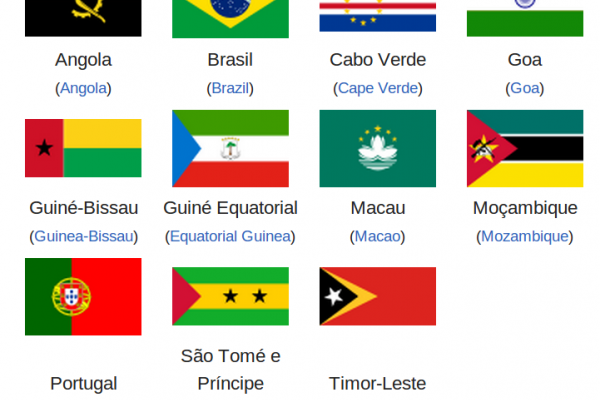
Today it is one of the world's major languages, ranked sixth according to number of native speakers (over 200 million). It is the language with the largest number of speakers in South America (188 million, over 51% of the continent's population), and also a major lingua franca in Africa. It is the official language of nine countries (see the table on the right), being co-official with Spanish and French in Equatorial Guinea, with Chinese in the Chinese special administrative region of Macau, and with Tetum in East Timor.
In July 2007, President Teodoro Obiang Ngumema announced his government's decision to make Portuguese Equatorial Guinea's third official language, in order to meet the requirements to apply for full membership of the Community of Portuguese Language Countries. This upgrading from its current Associate Observer condition would result in Equatorial Guinea being able to access several professional and academic exchange programs and the facilitation of cross-border circulation of citizens. Its application is currently being assessed by other CPLP members.
Spanish author Miguel de Cervantes once called Portuguese "the sweet language", whereas Brazilian writer Olavo Bilac poetically described it as a última flor do Lácio, inculta e bela: "the last flower of Latium, wild and beautiful".
Portuguese is the official language of Angola, Brazil, Cape Verde, Guinea-Bissau, Portugal, São Tomé and Príncipe and Mozambique. It is also one of the official languages of Equatorial Guinea (with Spanish and French), East Timor (with Tetum) and of the Chinese S.A.R. of Macau (with Chinese). It is widely spoken, but not official, in Andorra, Luxembourg, Namibia and Paraguay (in the latter country there were 112,520 native Portuguese speakers according to the 2002 census), and in the U.S. states of California, Connecticut, Florida, Massachusetts, New Jersey, New York, and Rhode Island. There is also a statistically significant Portuguese-speaking community (approximately 10,000 people) in Jersey. Portuguese Creoles are, while not officially recognized, the standard language for communication in Cape Verde and part of Guinea-Bissau's population. In Cape Verde most also speak standard Portuguese and have native level proficiency. There are also significant populations of Portuguese speakers in Canada (mainly concentrated in and around Toronto) and Bermuda. There are also small populations of speakers in the former Portuguese colonies of Goa and Daman and Diu which are now part of India.
Visit "Portuguese Language" on Wikipedia.
Rosetta Stone has consistently spent millions trying to place itself at the top of the list of proprietary methods. They claim it's intuitive, that it "allows you to learn a foreign language like you learned your native language". They've marketed effectively fancy themselves an international standard for diplomats, companies and organizations wishing to prepare for working and living abroad.
This software is proprietary and thus is no longer recommended by Free Language.
This is an excellent, high-quality podcast from the University of Texas for learners of Brazilian Portuguese - especially those that speak or have studied Spanish.
The lessons are well-designed by professors and the material is quite helpful.
Bravo UT!
Our podcasts are designed to help those who are learning Portuguese, especially if you have a previous background in Spanish. First, you find some pronunciation podcasts that are built around dialogs illustrating specific sound differences. You can also download pdf transcripts and participate in a discussion blog for clarification of questions.
Next, you find grammar podcasts that focus on grammatical differences between Spanish and Portuguese. All of the lessons are also built around some cultural aspect that makes Brazil so awesome.
Try it out, and join our Brazilpod community. There are no registration fees or restrictions, just great chances to learn more Portuguese.
Subscribe to Tá Falado Podcast.
Subscribe to Tá Falado Podcast via iTunes.